
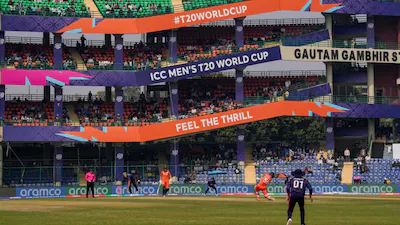

The Delhi and District Cricket Association (DDCA) is facing a tough week as it prepares to host five matches of the ICC T20 World Cup 2026 at the Arun Jaitley Stadium.
The first challenge is predictable — an India game. The February 12 clash against Namibia has witnessed overwhelming demand, with tickets sold out and requests for complimentary passes far exceeding availability.
The second concern, however, is more complicated.
For the non-India fixtures, DDCA officials reached out to schools, offering free entry to students in uniform accompanied by teachers in an effort to boost attendance and avoid empty stands. But with CBSE board exams for Classes 10 and 12 starting next week and many schools conducting annual exams around the same time, most institutions have declined the invitation.
“We contacted many schools, but with CBSE and annual exams overlapping with the tournament, institutions are not willing to send their students for non-India games. There is practically no demand for tickets except for the India match. Unlike Wankhede Stadium, where Nepalese fans filled nearly 17,000 seats, Kotla is likely to be less than half-full for other games,” a senior DDCA official overseeing arrangements told PTI on condition of anonymity.
Weekday scheduling has further added to the challenge.
“An empty stadium does not make for good television viewing, with large vacant sections becoming an eyesore. Bringing in schoolchildren seemed like a good idea. But we have matches on Tuesday (Feb 10), Thursday (India, Feb 12), Friday (Feb 13, UAE vs Canada), Monday (Feb 16, Afghanistan vs UAE), and Wednesday (Feb 18, South Africa vs UAE).
“If you remove the India game, all fixtures fall on weekdays. The non-India matches are scheduled at 11 am (three games) and 3 pm (one game). How do you expect working people or students to attend at those hours? There is hardly any interest even in premium tickets,” the official added.
While demand for India matches remains consistently strong, organisers in Delhi are grappling with a familiar reality of global tournaments — maintaining spectator interest when the host nation is not in action.