


The Marylebone Cricket Club (MCC) has issued a clarification on the law relating to “Obstructing the Field” following the controversial dismissal of Angkrish Raghuvanshi during an Indian Premier League match between Kolkata Knight Riders and Lucknow Super Giants.
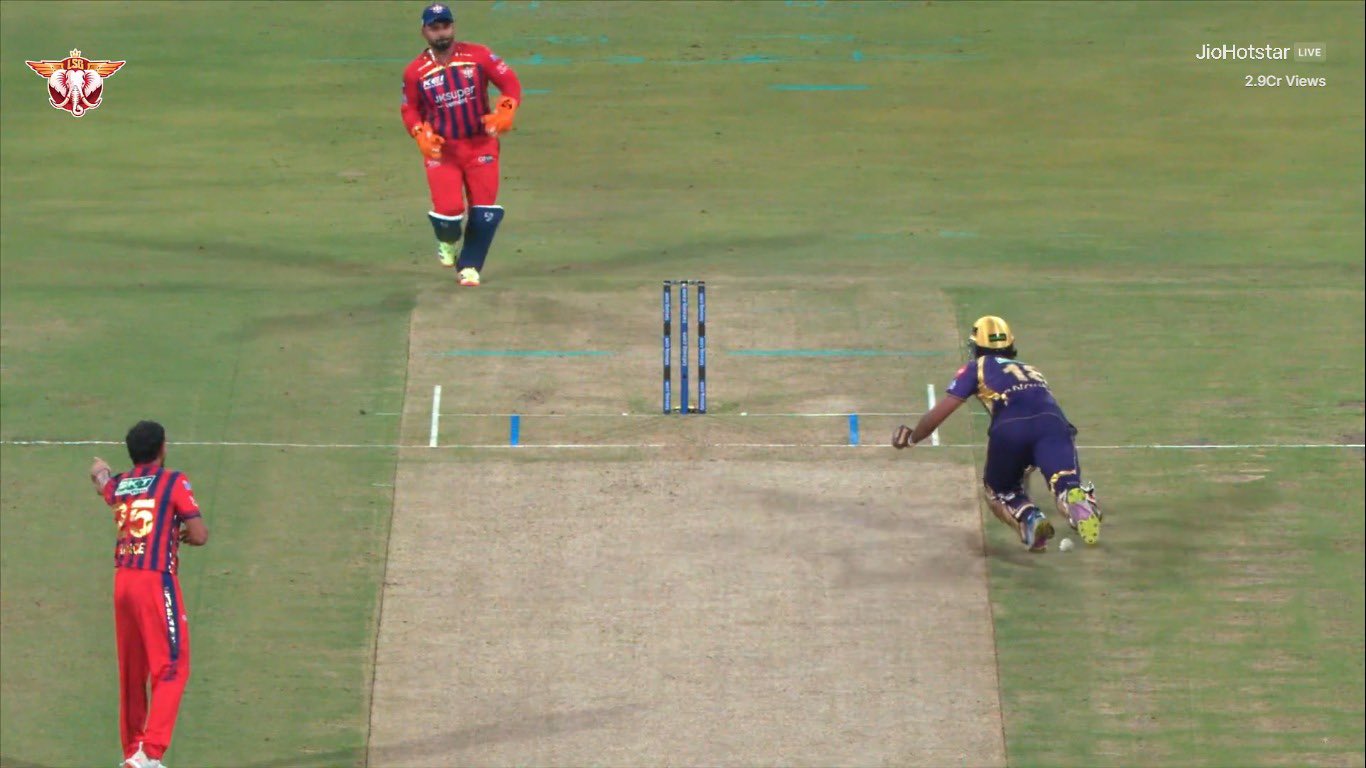
The incident occurred in the fifth over of KKR’s innings when Raghuvanshi, attempting a quick single, was sent back by his partner Cameron Green. As he dived to return to the crease, the throw from the field struck him. The LSG players appealed, and the decision was referred to the TV umpire, who ruled that Raghuvanshi had changed his running line and was therefore out for obstructing the field.
The young batter reacted in frustration, striking the boundary cushion with his bat and later throwing his helmet in the dugout. He was subsequently found guilty of a Level 1 offence under Article 2.2 of the IPL Code of Conduct, which relates to the abuse of cricket equipment or ground fixtures. He was fined 20 per cent of his match fee and handed one demerit point.
MCC Explains the Law
The dismissal triggered widespread debate, prompting the MCC to clarify the interpretation of Law 37.1.1. According to the law, a batter can be given out if they “wilfully attempt to obstruct or distract the fielding side by word or action.”
The MCC emphasised that intent is central to this law, even though it can be difficult to judge in real-time situations.
“A batter who changes direction while running, particularly one who crosses onto the pitch or takes a route that is not the quickest path, is making a wilful act,” the MCC stated.
Applying this principle, the MCC concluded that Raghuvanshi’s actions met the criteria for obstruction.
“When he set off for the run, he was on the off side of the wicket. As the ball reached the fielder, he moved towards the middle of the pitch — a line he should not have taken — and then turned back on the leg side, placing himself between the ball and the stumps. This is, by definition, a wilful act,” the MCC explained.
The governing body further clarified that had Raghuvanshi remained on the off side or returned via the same path, he would not have been considered out. It was specifically the act of crossing the pitch that led to the dismissal.
No Consideration of Outcome
Addressing another key point of debate, the MCC stated that whether the batter would have made his ground is irrelevant in such cases.
“Provided the obstruction does not prevent a catch, the likelihood of a run-out is not a factor in deciding Obstructing the Field,” the MCC added.
The clarification provides important context to a decision that sparked significant discussion, reinforcing that intent and movement — rather than outcome — are the key factors under the law.





