

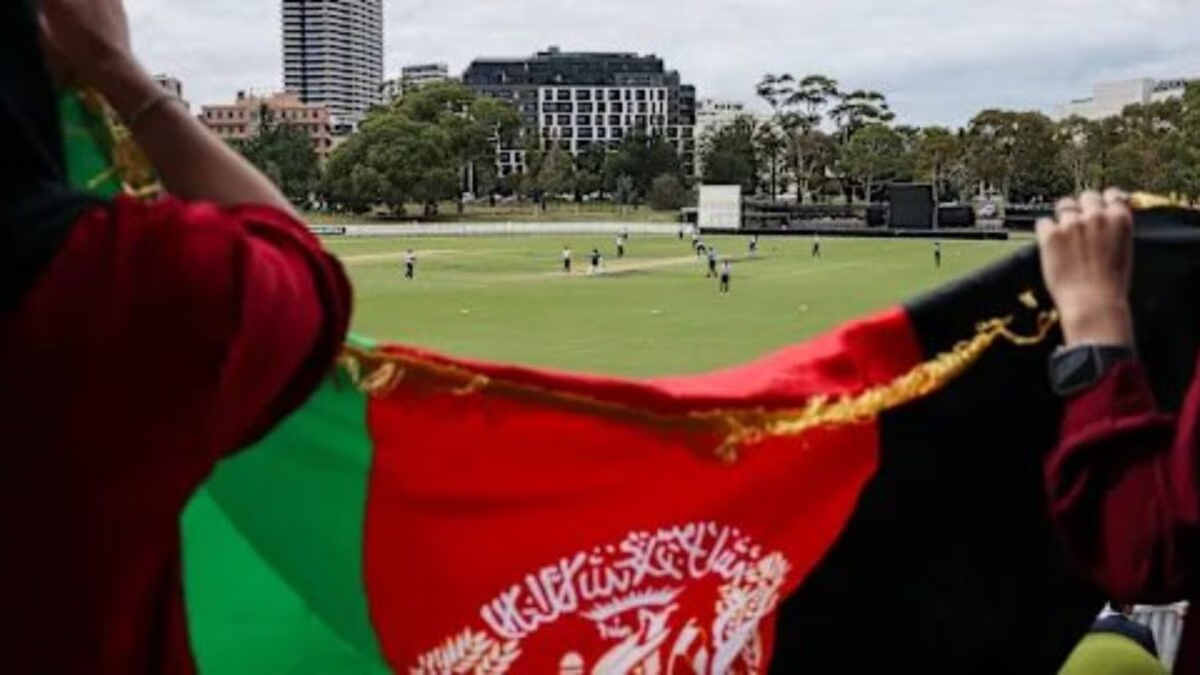

The International Cricket Council (ICC) has reaffirmed its commitment to supporting Afghan refugee women cricketers, approving the continuation of its Development Pathway Programme and setting an ambitious target of helping the team compete in the ICC qualification pathway by 2030.
The decision was taken during the ICC Board’s Annual Conference in Edinburgh, where the governing body also reconstituted its Special Task Force to develop a long-term roadmap for the team’s participation in ICC qualification events over the next five years.
The Task Force has been strengthened with the addition of ICC Independent Director Ros Rivaz and ICC Chief Executives’ Committee member Sarah Keane. They join existing representatives from the BCCI, Cricket Australia, and the England and Wales Cricket Board (ECB).
“The Task Force has been entrusted with developing a clear and sustainable roadmap that supports the continued development of Afghan refugee women cricketers through structured coaching, meaningful competitive opportunities and appropriate high-performance pathways,” Rivaz said in an ICC release.
Under the programme, the players will continue to receive access to specialist cricket coaching, strength and conditioning support, physiotherapy, and more competitive playing opportunities.
Cricketers based in Australia, England, and Canada will remain integrated into their local cricket systems, while the squad will continue to assemble for overseas training camps and tours, similar to those held in India and England over the past year.
The ICC also confirmed that the team’s collective playing opportunities will be expanded gradually against carefully selected opposition to prepare them for qualification events by 2030.
Afghan refugee cricketer Nahida Sapan welcomed the ICC’s long-term commitment.
“This programme has already made a real difference to us, not only by helping us continue playing cricket, but by enabling us to come together and play as a team. It is very reassuring to hear that the ICC and the Task Force are making a long-term commitment to supporting our development,” she said.
Teammate Firooza Afghan said the tours of India and England had been among the most memorable experiences of their lives and would serve as a strong foundation for the future.
“Over the past year, the opportunities to come together as a group and tour India and England have provided us with some of the most memorable experiences of our lives. The support to train in our home locations with quality coaches has played a huge role in our progress.”
“Having a long-term pathway towards ICC qualification gives us a clear goal to work towards, and we are determined to make the most of every opportunity along the journey,” she added.
Former Australia international Mel Jones, a co-founder of the It’s Game On initiative that supports the programme, described the ICC’s roadmap as a landmark step for the displaced cricketers.
“The continued support for these remarkable women, alongside a clear roadmap towards ICC qualification pathways by 2030, represents an important commitment to their future. It sends a powerful message that talent and determination deserve opportunity.”
“These players are role models who inspire women and girls around the world. The progress they’ve made over the past year has been extraordinary, and I’m excited to see what this team can achieve by 2030,” Jones added.





