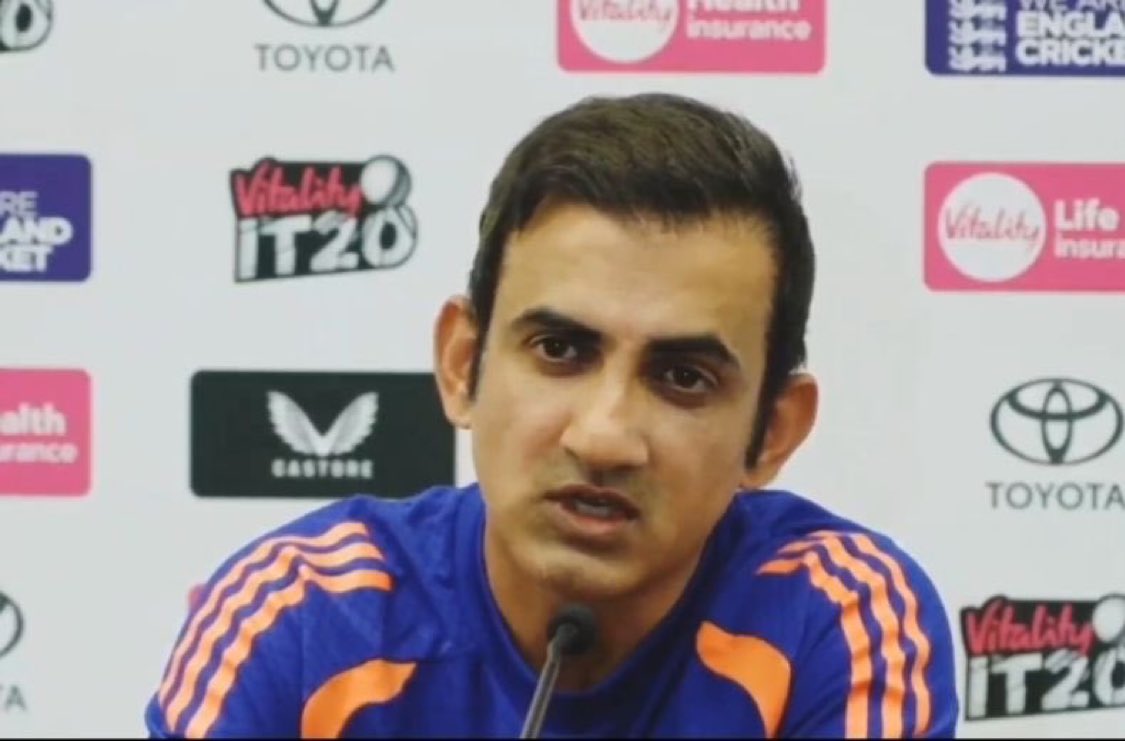
Following India’s meek surrender for just 76 all-out at Trent Bridge—marking their fourth consecutive T20I defeat—head coach Gautam Gambhir and captain Shreyas Iyer offered starkly contrasting assessments of the team’s historic 125-run loss. While the captain called the performance unacceptable, the head coach urged patience, pointing to a massive post-World Cup tactical reset.
Stepping up to the microphone after a brutal start to his captaincy tenure, Shreyas Iyer pulled no punches about India’s top-order capitulation.
Unacceptable Margin: Iyer bluntly labeled the defeat “atrocious” and stated that losing by such a massive margin is completely unacceptable.
Powerplay Disaster: The skipper pointed directly to the batting unit losing five wickets within the Powerplay as the moment the match was completely lost.
Back to the Drawing Board: Rejecting any excuses regarding the pitch, Iyer noted, “Looking at the wicket, I don’t think that it was a 200 wicket.” He demanded the team accept the loss and return to the drawing board to fix their execution.
Gautam Gambhir:
"We are a new team. After winning the last World Cup, we're trying a lot of new things. We've given opportunities to players like Vaibhav Sooryavanshi. Jasprit Bumrah isn't in the team, Hardik Pandya isn't in the team and we're making several changes overall!"… pic.twitter.com/9U4rC7v8ZR
Conversely, head coach Gautam Gambhir chose to view the collapse as an aberration—an occupational hazard of the high-risk, high-reward brand of cricket India swears by. He highlighted that India had crossed the 190-run mark in both previous games, proving the batting unit’s capability.
The Reality of the Transition
Gambhir repeatedly urged critics to be practical, reminding them of the vast difference between the current lineup and the one that lifted the World Cup four months ago.
“When you go to reset your T20 side, then many times you get such performances. If you see the playing XI of the World Cup final and the one today, there are a lot of changes. Hardik Pandya is not there, Jasprit Bumrah is not there… it takes a little time.” — Gautam Gambhir
Gambhir noted that throwing inexperienced players—like 15-year-old opener Vaibhav Sooryavanshi and Prince Yadav (playing just his second T20I)—into the deep sea against a high-quality England side requires giving them time to develop.
The Core Issue: Reading the Game Situation
Despite defending the squad’s youth, Gambhir repeatedly emphasized one glaring failure: the inability to read the game situation. He noted that India has struggled to assess conditions properly ever since their tour of Ireland.
Environmental Factors: Gambhir stressed that small variables, like the direction of the breeze and exploiting ground dimensions, make a huge difference in T20 cricket.
The Need for Anchors: He called on the experienced middle-order batters to recalibrate and adapt when the top order fails. He reminded the team that during their successful World Cup run, even when the top three played high-risk cricket, the middle order successfully anchored and built the innings—an element completely missing at Trent Bridge.
Clarity on the Sanju Samson Conundrum
Gambhir also addressed the ongoing selection drama surrounding Sanju Samson, who was benched in England and excluded from the upcoming Zimbabwe tour squad.
No Permanent Ouster: Gambhir clarified that there is absolute clarity between the management and Samson. He praised Samson’s “phenomenal” contributions during the World Cup but emphasized that selection currently dictates looking at a player’s immediate form.
Door Open for the Series: Stating that there is no hard-and-fast rule keeping him out, Gambhir confirmed that Samson could very well feature in the remaining two crucial matches against England as India looks to field its most result-oriented combination.